Delving into Westpac ASX Overview: Investing in Australian Finance Stocks, this introduction immerses readers in a unique and compelling narrative, with engaging and thought-provoking insights from the very start.
Exploring the history of Westpac ASX and its position in the Australian finance market sets the stage for understanding the key financial services offered and recent performance on the Australian Stock Exchange.
Overview of Westpac ASX
Westpac ASX, also known as Westpac Banking Corporation, is one of the “Big Four” banks in Australia, alongside Commonwealth Bank, ANZ, and NAB. Established in 1817, Westpac has a long history of providing financial services to Australians.
Position in the Australian Finance Market
Westpac holds a prominent position in the Australian finance market, offering a wide range of banking and financial services to individuals, businesses, and institutions. The bank has a strong presence across various segments of the market, including retail banking, corporate banking, wealth management, and insurance.
Key Financial Services Offered
- Personal banking services such as savings accounts, loans, and credit cards
- Business banking solutions including business loans and merchant services
- Wealth management services such as investment advice and financial planning
- Insurance products covering life, home, and car insurance
Recent Performance on the Australian Stock Exchange
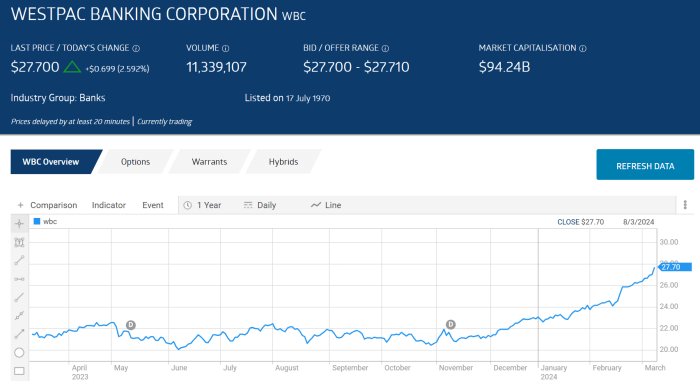
Westpac ASX has faced challenges in recent years, including regulatory issues and a tougher economic environment. The bank’s stock performance has reflected these challenges, with fluctuations in share price and profitability. However, Westpac continues to adapt and innovate to maintain its position in the competitive finance industry.
Investing in Australian Finance Stocks
Investing in Australian finance stocks like Westpac ASX can offer various benefits for investors looking to diversify their portfolio and tap into the stability of the financial sector.
Comparison with Other Major Players
When comparing Westpac ASX with other major players in the Australian finance industry, it’s essential to consider factors such as market share, revenue growth, profitability, and regulatory compliance. Companies like Commonwealth Bank of Australia, ANZ Banking Group, and National Australia Bank are key competitors that investors often analyze for investment opportunities in the finance sector.
Risks Associated with Investing
- Australian finance stocks are subject to market volatility, economic downturns, and regulatory changes that can impact the financial performance of these companies.
- Interest rate fluctuations and credit risks can also pose challenges for investors in the finance sector.
- Global economic conditions and geopolitical events can have a ripple effect on Australian finance stocks, making them susceptible to external factors beyond local control.
- Company-specific risks such as management changes, legal issues, and operational challenges can further add to the risks associated with investing in Australian finance stocks.
Performance Analysis of Westpac ASX
Investors often look at historical stock performance to gauge the potential of a company. In the case of Westpac ASX, understanding how the stock has performed over time can provide valuable insights into its future prospects.
Historical Stock Performance
- Westpac ASX has shown a consistent growth trajectory over the years, with fluctuations in line with market conditions.
- It is essential to analyze the stock’s performance during various economic cycles to understand its resilience and adaptability.
- Investors can look at key metrics such as price-to-earnings ratio and price-to-book ratio to assess the stock’s valuation and potential for growth.
Dividend Yield and Growth Potential
- Westpac ASX has a history of offering attractive dividend yields to investors, making it an appealing choice for income-seeking investors.
- The growth potential of Westpac ASX can be evaluated by looking at its expansion strategies, market position, and ability to innovate in a competitive landscape.
- Analysts often consider factors such as revenue growth, profit margins, and return on equity to assess the long-term growth prospects of the stock.
Impact of Economic Factors
- Economic factors such as interest rates, inflation, and GDP growth can significantly influence the performance of Westpac ASX.
- Changes in regulatory policies and market sentiment can also impact the stock’s performance, making it crucial for investors to stay informed and adapt their strategies accordingly.
- Understanding how economic indicators affect Westpac ASX can help investors make informed decisions and navigate market volatility effectively.
Strategies for Investing in Westpac ASX
When it comes to investing in Westpac ASX, there are several strategies that can help you make informed decisions and maximize your returns. Whether you are a beginner looking to dip your toes into the stock market or a seasoned investor, these strategies can guide you in your investment journey.
Tips for Beginners Investing in Westpac ASX
- Start with thorough research: Before investing in Westpac ASX or any other stock, take the time to research the company, its financial performance, market trends, and potential risks.
- Consider dollar-cost averaging: Instead of investing a large sum at once, consider spreading out your investments over time to reduce the impact of market volatility.
- Diversify your portfolio: Avoid putting all your money into a single stock like Westpac ASX. Diversifying your portfolio can help spread risk and potentially increase your returns.
Long-Term Investment Strategies for Maximizing Returns with Westpac ASX
- Focus on fundamentals: Look beyond short-term market fluctuations and focus on the long-term growth potential of Westpac ASX based on its financial health, management team, and competitive positioning.
- Reinvest dividends: If Westpac ASX pays dividends, consider reinvesting them to take advantage of compound growth over time.
- Stay informed: Keep track of the latest news, market trends, and developments related to Westpac ASX to make informed decisions about your investments.
Diversification Strategies when Including Westpac ASX in an Investment Portfolio
- Consider different asset classes: In addition to investing in individual stocks like Westpac ASX, consider diversifying your portfolio with bonds, real estate, and other assets to reduce risk.
- Allocate wisely: Determine the right balance of Westpac ASX and other investments based on your risk tolerance, financial goals, and time horizon.
- Regularly rebalance your portfolio: As market conditions change, periodically review and adjust your portfolio to maintain your desired asset allocation and risk level.
Epilogue
In conclusion, the discussion on Westpac ASX provides valuable insights into investing in Australian finance stocks, highlighting the benefits, risks, and strategies for maximizing returns in this dynamic market.
FAQ Guide
What is the historical stock performance of Westpac ASX?
The historical stock performance of Westpac ASX can be analyzed by looking at past trends and fluctuations in the stock price over time.
What are some tips for beginners looking to invest in Westpac ASX?
Beginners can start by researching the company, understanding their financial services, and considering their long-term growth potential before investing in Westpac ASX.
How does economic factors impact the performance of Westpac ASX?
Economic factors such as interest rates, inflation, and GDP growth can influence the performance of Westpac ASX as they affect the overall financial market conditions.










![Benefits of Servicing Your Air Conditioning Regularly [2024]](https://finance.radarcirebon.tv/wp-content/uploads/2025/07/Benefits-of-Air-Conditioning-Servicing-on-the-Regular-Featured-Image-980x551-1-120x86.jpg)